By Sang Lee — Founder and Editor of AssetCalculus
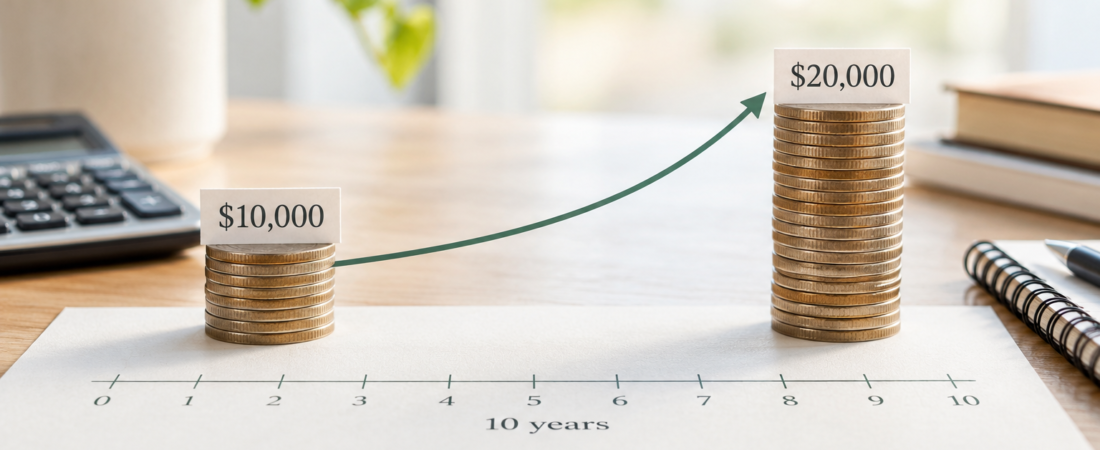
Quick answer: To turn $10,000 into $20,000 in exactly 10 years with no deposits or withdrawals, you need a compound annual growth rate of approximately 7.18% before taxes and fees.
The answer is not 10%. Doubling is a compounding problem: each year’s growth earns additional growth in later years.
The Exact Formula
Required return = (Ending value ÷ Beginning value)1 ÷ years − 1
For a doubling:
(20,000 ÷ 10,000)1 ÷ 10 − 1 = 7.1773%
Rounded to two decimal places, the required annual return is 7.18%.
Required Return to Double at Different Speeds
| Time to double | Required compound annual return |
|---|---|
| 5 years | 14.87% |
| 7 years | 10.41% |
| 10 years | 7.18% |
| 15 years | 4.73% |
| 20 years | 3.53% |
More time dramatically reduces the annual return required. Time is not a guarantee of profit, but it lowers the mathematical growth rate needed to reach a fixed target.
Year-by-Year Illustration at 7.18%
| Year | Approximate balance |
|---|---|
| 0 | $10,000 |
| 2 | $11,487 |
| 4 | $13,195 |
| 6 | $15,157 |
| 8 | $17,411 |
| 10 | $20,000 |
The Rule of 72
The Rule of 72 is a mental shortcut: divide 72 by an annual percentage rate to estimate doubling time. At 7.18%, 72 ÷ 7.18 is about 10 years. It is useful for quick estimates, but the exact compound formula is more accurate.
Fees Raise the Required Gross Return
If an investment charges a 0.50% annual expense and you still need a 7.18% net return, the simplified required gross return is roughly 7.68%. Other costs, taxes, and tracking differences can raise the hurdle further.
Inflation Changes the Goal
Doubling the number of dollars does not necessarily double purchasing power. If inflation averages 3% for 10 years, prices rise by about 34%. A $20,000 future balance would therefore represent much less than twice the purchasing power of $10,000 today.
Use the Inflation-Adjusted Return Calculator to measure the real result.
What If You Add Contributions?
Regular deposits reduce the return required to reach $20,000 because part of the ending value comes from new money rather than investment growth. Use the Compound Interest Calculator to model a starting amount plus monthly contributions.
Common Mistakes
- Dividing 100% by 10 years and assuming a 10% required return.
- Ignoring compounding frequency and contribution timing.
- Treating a historical return as a future guarantee.
- Ignoring fees, taxes, and inflation.
- Using CAGR when large deposits or withdrawals occurred.
- Assuming the investment will grow smoothly every year.
Use the CAGR Calculator
Enter $10,000 as the beginning value, $20,000 as the ending value, and 10 years in the CAGR Calculator. It returns approximately 7.18%.
Frequently Asked Questions
Will a 7.18% investment definitely double in 10 years?
No. The calculation assumes a constant compound return. Actual investments fluctuate and may lose value.
Does the calculation include taxes?
No. Taxes reduce the amount available to compound unless the money is held in a tax-advantaged arrangement.
What return doubles money in 20 years?
Approximately 3.53% per year before fees and taxes.
Bottom Line
A constant 7.18% annual compound return doubles $10,000 to $20,000 in 10 years. That is a mathematical target, not a forecast. Extend the time, add contributions, and account for fees and inflation when building a realistic plan.
Official Resources
Educational purposes only. Required-return calculations do not predict or guarantee investment performance.