By Sang Lee — Founder and Editor of AssetCalculus | Published by AssetCalculus
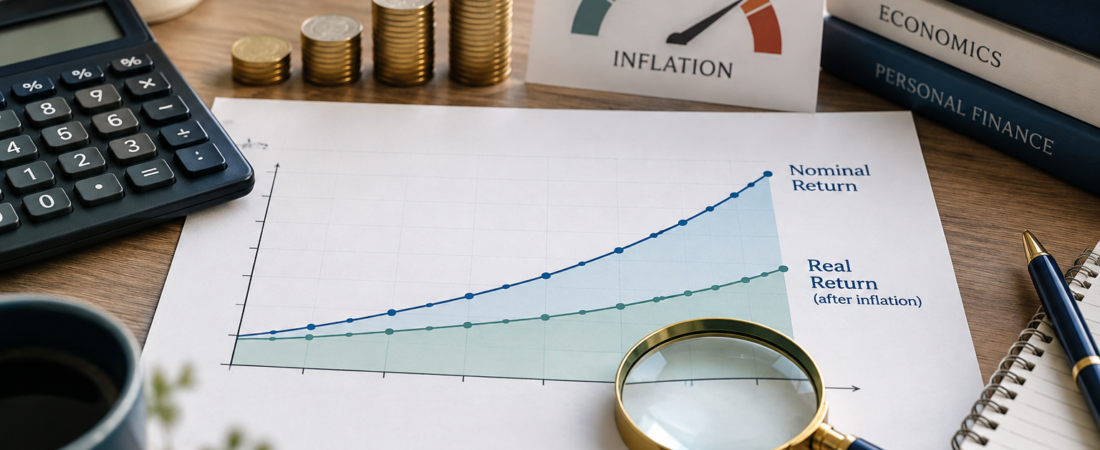
Quick answer: Nominal return is the percentage gain you see before adjusting for inflation. Real return estimates how much your purchasing power actually increased after inflation. If an investment earns 7% while prices rise 3%, the simple approximation is a 4% real return—but the exact inflation-adjusted result is slightly lower.
Nominal Return and Real Return Defined
Nominal return is the investment’s stated or observed return in current dollars. If $10,000 grows to $10,700, the nominal gain is $700, or 7%.
Real return adjusts that result for the change in purchasing power caused by inflation. Investor.gov defines real return as what an investment earns after accounting for inflation and taxes. In practice, many educational calculations first isolate the inflation effect, then discuss taxes and fees separately.
Why Inflation Changes the Meaning of a Gain
A higher account balance does not automatically mean you can buy proportionally more goods and services. The Bureau of Labor Statistics explains that the Consumer Price Index measures the change over time in prices paid by consumers for a representative basket of goods and services. When that price level rises, each dollar generally buys less.
Suppose an investment rises 5% during a year when consumer prices rise 4%. The investor has more dollars, but most of the gain merely keeps pace with higher prices. The real improvement in purchasing power is close to 1%, before taxes and investment costs.
The Exact Real-Return Formula
The exact inflation-adjusted formula is:
Real return = [(1 + nominal return) ÷ (1 + inflation rate)] − 1
Write the percentages as decimals. With a 7% nominal return and 3% inflation:
(1.07 ÷ 1.03) − 1 = 0.0388, or about 3.88%
Subtracting inflation directly gives 4%. That shortcut is useful for quick estimates when both rates are modest, but 3.88% is the more precise answer.
| Nominal return | Inflation | Approximate real return | Exact real return |
|---|---|---|---|
| 7% | 3% | 4% | 3.88% |
| 5% | 4% | 1% | 0.96% |
| 3% | 5% | −2% | −1.90% |
| 10% | 2% | 8% | 7.84% |
A Dollar Example
Imagine that $20,000 earns a 6% nominal return. After one year, the balance is $21,200 before fees and taxes. If inflation is 3.5%, the exact real return is about 2.42%:
(1.06 ÷ 1.035) − 1 ≈ 0.0242
In purchasing-power terms, the gain is closer to $484 in starting-year dollars than the $1,200 nominal gain shown on the statement. The nominal number is correct; it simply answers a different question.
What Counts as the Inflation Rate?
The CPI is a broad national measure, not a personalized cost-of-living index. Your own spending may be concentrated in categories that rise faster or slower than the overall index. Housing, insurance, medical care, transportation, and education can affect households differently.
For a consistent comparison, match the time periods. Compare a one-year investment return with inflation measured across the same one-year span. Mixing a monthly inflation change with an annual investment return will produce a misleading result.
Negative Real Returns
A positive nominal return can still be a negative real return. If an account earns 3% while inflation is 5%, the balance rises in dollars but loses purchasing power. The exact real return is approximately −1.90%.
This distinction is especially important for cash, bonds, and other fixed-rate holdings. It does not mean a lower-risk account is automatically a poor choice; liquidity, principal stability, time horizon, and risk tolerance still matter. It means the advertised rate should be evaluated in context.
Taxes and Fees Matter Too
Inflation is not the only drag on an investment result. Fund expenses, account fees, trading costs, and taxes can reduce the amount you keep. A complete personal calculation may therefore compare an after-fee, after-tax nominal return with inflation. Tax treatment varies by investment and investor, so consult a qualified tax professional for individual guidance.
Try the AssetCalculus Calculator
Use the Inflation-Adjusted Return Calculator to compare a nominal return with an inflation rate and see the estimated change in purchasing power. For longer-term growth scenarios, the Compound Interest Calculator can show how an assumed rate compounds over time.
Frequently Asked Questions
Is real return always lower than nominal return?
When inflation is positive, real return is lower. During deflation, the inflation-adjusted result can be higher than the nominal return.
Can I just subtract inflation?
Yes for a quick estimate. Use the division formula when you want the precise inflation-adjusted percentage.
Does CPI equal my personal inflation rate?
No. CPI summarizes price changes for a broad population and market basket. Your spending pattern may differ.
Bottom Line
Nominal return tells you how much the dollar value of an investment changed. Real return tells you how that gain looks after inflation reduces purchasing power. Both are useful, but real return gives a clearer picture of whether wealth actually grew in economic terms.
Educational note: This article is for general educational and informational purposes only. It does not constitute individualized financial, investment, tax, or legal advice.