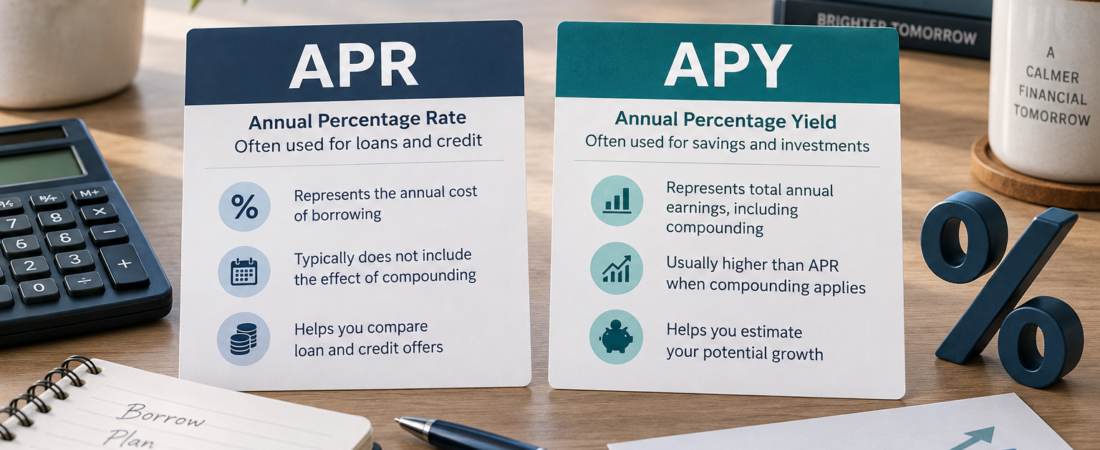
APR and APY both express an annual percentage, but they answer different questions. APR commonly describes the annual cost of borrowing, while APY describes what savings can earn after compounding is included. Understanding the difference helps you compare loans, credit cards, savings accounts, and certificates of deposit more accurately.
The shortest version is: APR focuses on the stated annual rate; APY reflects compounding. But fees, payment timing, and product rules still matter, so neither number should be used without reading the details.
APR vs. APY at a Glance
| APR | APY | |
|---|---|---|
| Full name | Annual Percentage Rate | Annual Percentage Yield |
| Common use | Loans and credit | Savings and deposit accounts |
| Compounding | Usually does not show intra-year compounding in the quoted rate | Includes compounding over one year |
| Helpful for | Comparing borrowing costs | Comparing potential deposit earnings |
What Is APR?
APR stands for annual percentage rate. For many loans, it is designed to give borrowers a broader annualized measure of credit cost than the interest rate alone. Depending on the product and applicable disclosure rules, APR may incorporate certain finance charges. That is why a loan can advertise one interest rate but show a different APR.
APR is useful when you compare offers with the same loan amount and term. Still, look at the monthly payment, total of payments, fees, prepayment rules, and whether the rate can change. A lower APR does not automatically make a longer or larger loan cheaper in total dollars.
What Is APY?
APY stands for annual percentage yield. It estimates the amount a deposit can earn in one year when compounding is included, assuming the disclosed rate and balance conditions apply. More frequent compounding can make APY slightly higher than the underlying nominal rate.
APY makes it easier to compare deposit products with different compounding schedules. However, an account can still have minimum balances, tiered rates, withdrawal limits, promotional periods, or fees that reduce what you actually keep.
Why Compounding Creates a Difference
Suppose $10,000 earns a nominal 5% annual rate compounded monthly. The monthly rate is 0.05 ÷ 12. After 12 compounding periods, the balance is approximately $10,511.62, producing an APY of about 5.116%.
The formula is:
APY = (1 + r ÷ n)n − 1
Here, r is the nominal annual rate and n is the number of compounding periods per year. Use the AssetCalculus Compound Interest Calculator to test different rates, balances, and compounding schedules.
Example: 5% APR vs. 5% APY
| Quoted measure | Meaning in a simplified $10,000 example |
|---|---|
| 5% APR | A stated annual borrowing rate; actual cost depends on balance, payments, fees, and product terms |
| 5% APY | About $500 earned over one year if the balance and APY remain applicable, before taxes or fees |
The two percentages should not be compared as if they describe the same cash flow. Borrowing requires payments and may include fees. Deposits earn interest and may have changing balances. Always compare like with like.
How to Compare Loan Offers Using APR
- Use the same loan amount and repayment term.
- Compare fixed rates with fixed rates and variable rates with variable rates.
- Check which fees are included in APR and which are not.
- Review the monthly payment and total dollar cost.
- Ask whether there is a prepayment penalty.
How to Compare Savings Accounts Using APY
- Confirm whether the APY is promotional or ongoing.
- Check minimum-balance and tier requirements.
- Subtract monthly fees you expect to pay.
- Review withdrawal access and early-withdrawal penalties.
- Verify deposit insurance eligibility and limits.
Common Mistakes
- Comparing a loan APR with a savings APY: they describe different products and cash flows.
- Ignoring fees: fees can change the effective result.
- Assuming a rate lasts forever: variable and promotional rates can change.
- Focusing only on percentages: term length and balance determine the dollar impact.
- Forgetting taxes: taxable interest may reduce your after-tax return.
Frequently Asked Questions
Why is APY higher than the stated interest rate?
APY includes the effect of earning interest on previously credited interest. The difference grows with higher rates and more frequent compounding.
Does a lower APR always mean a cheaper loan?
Not always in total dollars. A longer term or larger balance can cost more even with a lower APR. Compare the complete payment schedule and fees.
Is APY guaranteed?
Only under the product’s stated conditions. Variable deposit rates can change, and fees or withdrawals can reduce actual earnings.
Bottom Line
APR helps you evaluate borrowing cost, while APY helps you evaluate deposit growth after compounding. Use each measure for its intended purpose, then confirm fees, term, balance rules, and total dollars before making a decision.
This article is for general educational and informational purposes only. It does not constitute individualized financial, investment, tax, or legal advice.